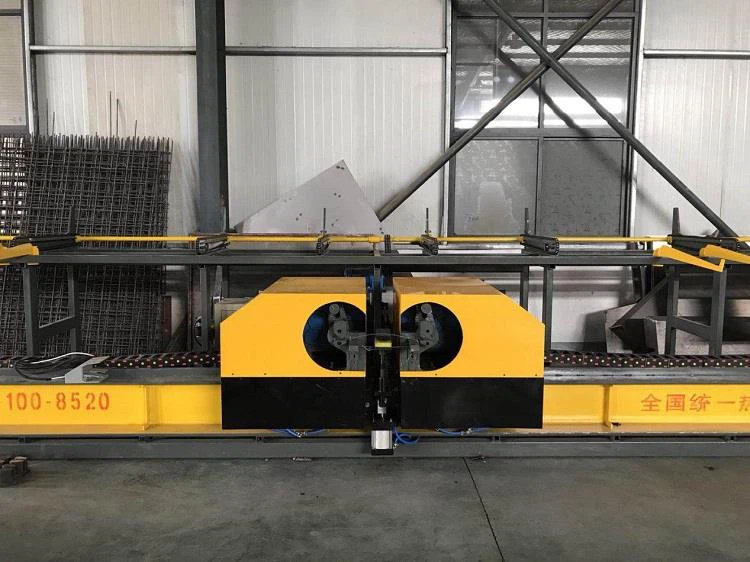
G2L40A CNC Rebar Bending Center
Automatic Rebar Bending Machine has the advantages of simple operation and convenient and economical operation. It is especially suitable for all kinds of engineering tenders and steel refineries.
G2L40A CNC Rebar Bending Center Description
The vertical rebar bending center is a CNC rebar processing equipment. It features simple and convenient operation and high cost-effectiveness. It is especially suitable for bidding of various engineering projects and rebar processing plants, and serves as essential equipment promoted by the state for standardized rebar processing. It has been widely applied in steel structure projects such as highways, high-speed railways, intercity railways, metro and light rail in China.
The bending head is driven by a servo motor to realize digital control of length and angle, with fast response and precise positioning of the bending head. The bending motor adopts frequency conversion technology, delivering high precision and energy efficiency in rebar machining, and can process rebars of various specifications. The machine bracket and guide rails of the bending platform adopt high-strength moving rails, which are sturdy, durable and resistant to deformation. Equipped with a high-strength automatic feeding rack, it supports continuous production.
The whole machine only requires one operator on duty, which greatly saves labor costs. It guarantees good consistency of finished products and reduces waste and rework. It is the preferred equipment for centralized prefabricated rebar processing.
Main Feature:
- Flexible steel bar locking mechanism to ensure forming accuracy.
- The telescopic bending shaft realizes the bidirectional bending of steel bars with high efficiency.
- Mobile bending host, the bending length is automatically determined.
- The bending spindle adopts frequency conversion control, with high bending accuracy.
- The vertical bending center occupies less floor space and effectively cuts site costs.
- Capable of processing high-strength steel bars HRB400 and HRB500, suitable for road & bridge, high-speed railway, building construction, metro and other projects.
| TECH PARAMETER | ||
| Model | G2L40A | |
| Diameter of steel bar | Bending angle | |
| Capacity | Φ6-Φ40 | +180°、-120° +90°、-90° |
| Main bender speed | 0.6 m/s | |
| Bending speed | 60°/s | |
| Bending error | ±1 mm/m | |
| Min axis spacing | 490 mm | |
| Power | 19.5 kW | |
| Overall dimensions | 13.5×2.15×1.6 m | |
| Weight | 6T | |
FAQ of Vertical Steel Bar Bending Center
Q: What sizes of steel bars can the vertical steel bar bending center process, and what projects is it mainly applied to?
A: It can process HRB400/500 deformed steel bars, covering Φ10–Φ50. Widely used in high-speed rail, subway, highway & bridge projects, precast component factories, and centralized steel processing yards for building construction to meet standardized steel cutting and forming requirements.
Q: How much labor can the vertical bending center save compared with traditional manual bending?
A: Traditional bending work requires 4–6 workers. The CNC vertical bending center only needs 1–2 workers for material feeding and supervision. It greatly cuts labor costs, realizes automatic continuous forming, reduces human errors and improves processing stability.
Q: Is the equipment difficult to operate? Do workers need long-time training?
A: Equipped with a CNC system and intuitive interface; parameters can be preset and saved. Ordinary workers can operate it after short training. It supports drawing import and digital dimension setting, and quick adjustment for different bar specifications.
Q: What about the precision and stability of the vertical steel bar bending center?
A: Servo motors drive the head positioning, with variable-frequency bending motors for high positioning accuracy. The machine body adopts high-strength moving rails with strong rigidity and wear resistance. Finished steel bars feature consistent dimensions and less rework.
Q: Can the equipment bend steel bars into multiple shapes in one cycle?
A: It supports one-time forming of various stirrups and special-shaped main bars. Bending angles and sizes can be flexibly switched to meet the processing demands of different steel components, one machine for multiple uses.
Q: Is daily maintenance complicated? What about after-sales support?
A: Main maintenance tasks include rail lubrication and regular inspection of wearing parts, easy to maintain. The whole machine adopts modular structure for convenient replacement of consumables. The manufacturer provides installation & commissioning, technical training and warranty service.